Getting from Narita Airport to Tokyo can take roughly 40 minutes to well over an hour, depending on the destination, service and transfers. There’s no single “best” train: the right choice depends on your hotel’s area, your budget, and how much luggage you have.
Quick answer
- Ueno or Nippori: the Keisei Skyliner is usually fastest (36 minutes to Nippori at its quickest).
- Tokyo Station, Shinjuku, Shibuya or Yokohama: the JR Narita Express (N’EX) gets you there without changing trains.
- Cheapest train to Ueno: Keisei Main Line Limited Express / Rapid Limited Express trains, which cost less than the Access Express on that route.
- Asakusa or Higashi-Ginza: the Keisei Access Express often runs through without a transfer.
- Cheap and simple to Tokyo Station or Ginza: the Airport Bus TYO-NRT costs ¥1,500 for daytime services.
- Lots of luggage, small children or a late arrival: a bus that stops near your hotel, or a fixed-fare taxi.
Figures are adult one-way fares and travel-time estimates reviewed against operator information in October 2026. Some regular Keisei fares remain approximate because its official pages show inconsistent amounts. Confirm your route and the latest fare before travel.
Narita Airport to Tokyo: Quick Comparison
Each option serves a different part of Tokyo, so each fare below is to that option’s main destination. They aren’t prices for the same trip.
| Transport option | Main destination | Approx. fare | Typical time | Transfers | Luggage | Best for |
|---|---|---|---|---|---|---|
| Keisei Skyliner | Nippori, Keisei-Ueno | ¥2,580 (¥2,310 online) | 36 min to Nippori, 41 min to Ueno (fastest) | None to Ueno | Luggage space in every car | Speed to Ueno |
| JR Narita Express (N’EX) | Tokyo, Shinagawa, Shibuya, Shinjuku, Yokohama | ¥3,140 to Tokyo; ¥3,330 to Shinjuku/Shibuya | From 53 min to Tokyo; longer to other stops | None to major JR stations | Large luggage areas | Hotels on the JR network |
| Keisei Access Express | Oshiage, Asakusa, Higashi-Ginza | Around ¥1,300 to Asakusa | About 50 min to Asakusa | Often none to Asakusa | Commuter train; limited space | Asakusa on a budget |
| Keisei Main Line (Ltd. Exp. / Rapid Ltd. Exp.) | Nippori, Keisei-Ueno | About ¥1,050 to Ueno | About 80 min to Ueno | None to Ueno | Commuter train; limited space | Cheapest train to Ueno |
| Airport Bus TYO-NRT | Tokyo Station, Ginza | ¥1,500 (¥3,000 late night / early morning) | About 65–70 min to Tokyo Station, traffic permitting | None | 1 suitcase in the hold | Budget trips to Tokyo Station |
| Airport Limousine Bus | Major stations and hotel areas | Varies by route — check official site | Varies by route and traffic | None | Bags go in the hold | Getting close to your hotel |
| Taxi / private transfer | Any address | Fixed fares from ¥23,500, plus tolls | Traffic dependent | None | Door to door | Groups, families, late arrivals |
← Swipe to see the full table →
Best Way from Narita Airport to Tokyo by Destination
The best Narita Airport to Tokyo train depends on your hotel’s nearest station, so start there. The train or bus only gets you that far, and you still have to walk, take a subway or catch a short taxi to the hotel. With heavy bags, one direct ride and a short walk can beat a faster train with two transfers.
Tokyo Station / Marunouchi
- Best: the N’EX (direct, from 53 minutes, ¥3,140), or the TYO-NRT bus (¥1,500, about 65–70 minutes, traffic permitting).
- Alternative: the Skyliner to Nippori, then the JR Yamanote Line. Keisei lists about 47 minutes of riding time on this route; allow additional time for the transfer.
Ueno / Nippori
- Best: the Skyliner (41 minutes to Keisei-Ueno at its quickest, ¥2,580).
- Budget: Keisei Main Line trains, which run direct to Keisei-Ueno for about ¥1,050 but take roughly twice as long.
- Last leg: Keisei-Ueno is a separate station next to JR Ueno and the subway, so allow a few minutes’ walk.
Shinjuku and Shibuya
- Best: the N’EX, direct to either station (¥3,330).
- Alternative: the Skyliner plus the JR Yamanote Line. It’s cheaper, but you change trains with your bags. Keisei lists about 64 minutes of riding time to Shibuya.
- By bus: airport buses serve both areas. The airport lists a low-cost bus to Shibuya Station for ¥2,500.
Asakusa
- Best: the Access Express. Many trains run straight onto the Toei Asakusa Line, reaching Asakusa in about 50 minutes.
- Check: Access Express trains go to different places, so check the destination on the platform display before you board.
Ginza
- Best: the TYO-NRT bus to Ginza Station (about 80 minutes from Terminal 1, traffic permitting).
- By train: an Access Express that runs through to the Toei Asakusa Line reaches Higashi-Ginza without a transfer.
Yokohama
- Best: the N’EX to Yokohama Station (¥4,480). Not every N’EX goes to Yokohama, so check before you board.
- By bus: the airport lists buses to Yokohama City Air Terminal (YCAT) and Minato Mirai.
Keisei Skyliner: Fast Travel to Ueno and Nippori
The Skyliner is a limited express that runs at up to 160 km/h on the Narita SKY ACCESS Line, about three times an hour. Keisei lists 36 minutes to Nippori and 41 minutes to Keisei-Ueno as the fastest times.
- Stops: most trains run non-stop to Nippori, but some also stop at Aoto and Shin-Kamagaya.
- Seats: all seats are reserved, so you always get one.
- Luggage: every car has a luggage area next to the vestibule.
- Transfers: at Nippori you can change to JR lines, including the Yamanote Line. Keisei-Ueno is next to JR Ueno and the Tokyo Metro.
Skyliner tickets and fares
The ¥2,580 fare is made up of the base fare (¥1,280) and the Skyliner ticket (¥1,300). Keisei’s official discounted one-way ticket is ¥2,310 when purchased through an eligible channel. At the airport you can buy tickets from the Skyliner counters and ticket machines, and both take major credit cards.
Using Suica or PASMO on the Skyliner
An IC card pays only the base fare, so you still need a Skyliner ticket. If you board without one, Keisei adds an onboard surcharge (¥300 for adults).
JR Narita Express: Convenient for Tokyo and Shinjuku
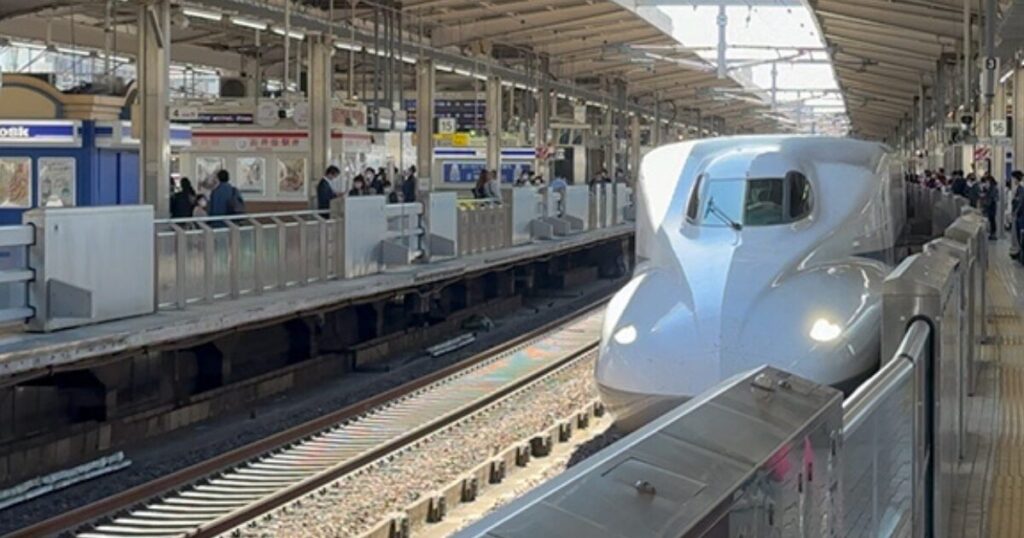
The N’EX is JR East’s limited express from Narita to Tokyo, Shinagawa, Shibuya, Shinjuku and Yokohama. The fastest trip to Tokyo Station takes 53 minutes. Its main advantage is reaching the west and south of the city without a transfer.
Tickets and fares
The fare is a base fare plus a limited express charge. JR East lists these one-way totals (Ordinary Car): Tokyo ¥3,140; Shinagawa, Shibuya and Shinjuku ¥3,330; Yokohama ¥4,480.
Buy at the JR ticket offices or reserved-seat ticket machines in the airport stations, or online through JR-EAST Train Reservation up to one month ahead. You can tap Suica or PASMO for the base fare, but you still need a separate limited express ticket. JR East also offers a limited express ticket without a preassigned seat; if you use it, you may sit in an available Ordinary Car seat but must give it up if its reserved passenger arrives.
N’EX TOKYO Round Trip Ticket
JR East lists the N’EX TOKYO Round Trip Ticket for eligible international visitors at ¥5,200. It’s valid for 14 days and covers one trip from Narita into the Tokyo area and one trip back, which may be from a different station. Two one-way tickets to Tokyo Station would cost ¥6,280. You collect the ticket at the airport stations, and eligibility rules apply, so check JR East’s page before you buy.
Luggage and rail passes
The luggage spaces on board don’t need a reservation, but they’re first-come, first-served. Some passes, including JR East passes and the Japan Rail Pass, can be used on the N’EX. Check your pass’s conditions and reserve a seat.
Keisei Access Express vs Keisei Main Line
Many guides get this wrong: the Access Express is not always the cheapest train. Both are ordinary Keisei trains with no extra charge, but they take different routes.
| Access Express | Main Line Limited Express / Rapid Limited Express | |
|---|---|---|
| Route | Narita SKY ACCESS Line (faster, more direct) | Keisei Main Line via Funabashi (slower, more stops) |
| Mainly serves | Oshiage, Asakusa, Higashi-Ginza; some trains continue to Haneda Airport | Nippori, Keisei-Ueno |
| Fare to Keisei-Ueno | Higher — about ¥1,250–1,300 | Lower — about ¥1,050 |
| Time | About 50 min to Asakusa | About 80 min to Keisei-Ueno |
| Seats | No reservations; commuter seating | No reservations; commuter seating |
| Frequency | Fewer trains | More trains |
← Swipe to see the full table →
The simple rule: take the Main Line for Ueno or Nippori on a budget, and the Access Express for Asakusa, Higashi-Ginza and other stations on the Toei Asakusa Line.
The two routes have different fares, and published fare tables may not reflect the newest prices, so check the current fare at the station or operator route search. A paper ticket must match the route. Tell the counter staff where you’re going. With an IC card, the fare is worked out automatically.
Traveling with big suitcases?
These are commuter trains with no guaranteed space for large suitcases, and they get crowded closer to Tokyo at rush hour. With more than one large bag each, the Skyliner, the N’EX or a bus will be far more comfortable.
Airport Buses: Budget Bus vs Limousine Bus
Airport Bus TYO-NRT
- Route: Tokyo Station, Ginza Station and Shinonome.
- Fare: ¥1,500 for adults and ¥750 for children. Late-night and early-morning buses cost ¥3,000.
- Time: about 65–70 minutes to Tokyo Station, and about 80 minutes to Ginza from Terminal 1. Traffic can add more.
- How to ride: buy a ticket for a specific bus at the bus counter in arrivals. Seats aren’t assigned, and standing isn’t allowed, so a full bus won’t take you.
- Luggage: one suitcase per person in the hold, up to about 158 cm in total dimensions. Golf bags, ski bags, boxes and extra bags aren’t accepted.
- Last bus: pay on board with cash or an IC card. Credit cards aren’t accepted for it.
Airport Limousine Bus
- Route: major stations and hotel areas across Tokyo. Routes and stops change, so check the official route list for your hotel. Don’t assume a bus stops at it.
- Why choose it: your bags go in the hold, and a stop near your hotel saves a transfer.
- Tickets: reserve online for a QR ticket, or buy at the counter in arrivals. Fares vary by route.
Traffic delays
Airport buses use expressways into Tokyo, and rush hour, holidays and accidents can add a lot of time. If your schedule is tight, a train is more predictable.
Taxi and Private Transfers from Narita
A taxi costs far more than the train, but it takes you door to door. It suits families with small children, groups sharing the cost, travelers with lots of luggage, and arrivals after the last train.
The airport lists fixed-fare taxis to zones in Tokyo, run by members of the Narita International Airport Taxi Council. Examples via the Keiyo Road:
- Chiyoda, Chuo, Taito and nearby wards (Tokyo Station, Ginza, Ueno, Asakusa): ¥29,000
- Shinjuku, Shibuya, Minato (excluding Daiba) and nearby wards: ¥31,500
Expressway tolls are extra, a surcharge applies from 22:00 to 5:00, and some routes cost more. No reservation is needed. Tell the driver you want the fixed fare before you set off.
For pre-booked private transfers, confirm before booking whether tolls and night surcharges are included, the luggage limit, and what happens if your flight is late.
Where to Catch Your Train or Bus at Narita Airport
Narita has three terminals but only two railway stations, both underground:
- Terminal 1: Narita Airport Station (Terminal 1), about a 5-minute walk.
- Terminal 2: Airport Terminal 2·3 Station, about a 5-minute walk.
- Terminal 3: no station. Walk to Airport Terminal 2·3 Station via the access corridor (allow about 10–15 minutes; the airport’s detailed route guide says approximately 13 minutes from the arrivals information counter to the ticket gates), or take the free terminal shuttle bus to Terminal 2 (about 3 minutes on board, plus waiting and walking time). Many low-cost airlines use Terminal 3, so allow extra time.
Both stations serve the Skyliner, the Access Express, Main Line trains and the N’EX, so you can decide after you land. Buses leave from stops outside each terminal’s arrivals floor.
Get cash before you go down to the station
Keisei says the station ticket floors have few or no ATMs and exchange counters. Use the ones in the arrivals lobby (1F) first.
How to Buy Tickets and Use Suica or PASMO
- Ticket machines: have an English option. Keisei’s regular machines sell base fare tickets, and Skyliner tickets are sold at the Skyliner counters and machines.
- Payment: Keisei takes credit cards for Skyliner tickets, but its FAQ says other Keisei tickets must be paid in cash (yen). JR’s reserved-seat ticket machines accept credit cards.
- Staffed counters: the easiest choice if you’re unsure which train to take.
- Online: Skyliner e-tickets from Keisei, and N’EX tickets from JR-EAST Train Reservation.
Where IC cards work, and where they don’t
- Access Express and Main Line: tap in and out. No other ticket needed.
- Skyliner and N’EX: the card pays the base fare only, so you also need a Skyliner ticket or a limited express ticket.
- Airport buses: rules differ by company and service, so don’t assume every bus takes IC cards.
Keisei says PASMO cards are sold from ticket machines in both airport stations. For top-ups and phone wallets, see How to Use Suica & PASMO in Japan. For gates, platforms and transfers, see How to Use Trains in Japan.
What If You Arrive Late at Night?
Your landing time isn’t the time you’ll leave the airport. Immigration, baggage claim and customs can take an hour or more when several international flights arrive together.
- Last trains: they leave in the late evening, and each line’s last departure is different. Check the timetable for your date before you fly.
- JR tickets: check the current opening hours of airport ticket offices and reserved-seat machines, particularly for late arrivals. Some facilities may close before the final train.
- Late-night buses: TYO-NRT runs some late-night and early-morning buses at the ¥3,000 fare.
- Taxi: available after the trains stop, with the night surcharge.
- Stay nearby: the airport lists nearby hotels with shuttle buses, and a 24-hour capsule hotel in the parking building next to Terminal 2. Book ahead.
Parts of each terminal and some convenience stores are open 24 hours. If you land very late, a night near the airport and a morning train is often cheaper and calmer than a long taxi ride.
If trains are delayed or suspended
Keisei and JR run on separate lines for most of the way, so one may keep running when the other stops, for example in a typhoon. Airport buses are another fallback. Check each operator’s service status and ask station staff. Mobile data on arrival helps a lot here. Our Internet in Japan guide covers eSIM and Wi-Fi options.
Which Option Should You Choose?
- Solo traveler: the train that serves your hotel’s area, or TYO-NRT on a tight budget.
- Couple: the same. If you’re flying home from Narita, compare the N’EX TOKYO Round Trip Ticket with buying one-way tickets.
- Family with children: reserved seats on the Skyliner or the N’EX, or a fixed-fare taxi for three or four people with bags.
- Large luggage: the Skyliner, the N’EX or a bus. Avoid commuter trains at rush hour.
- Budget traveler: the Main Line to Ueno, the Access Express to Asakusa, or TYO-NRT to Tokyo Station.
- Late-night arrival: check last departures before you fly, and have a late bus, a taxi or a nearby hotel as your backup.
- First-time visitor: pick the option that reaches your hotel’s station without a transfer, even if it costs a little more.
Frequently Asked Questions
What is the cheapest way from Narita Airport to Tokyo?
To Ueno, it’s the Keisei Main Line, at about ¥1,050. To Tokyo Station, TYO-NRT is a low-cost direct option at ¥1,500 in the daytime, although a train journey involving transfers may be cheaper. The Access Express costs more than the Main Line to Ueno.
Is the Narita Express better than the Skyliner?
Neither is better everywhere. The Skyliner is faster and cheaper to Ueno and Nippori. The N’EX is easier for Tokyo Station, Shinjuku, Shibuya and Yokohama because you don’t have to change trains.
Can I use Suica or PASMO from Narita Airport?
Yes. It covers the whole trip on the Access Express and Main Line. On the Skyliner and the N’EX it covers only the base fare, so you need an extra ticket.
Does the Skyliner go to Tokyo Station?
No. It ends at Keisei-Ueno. For Tokyo Station, change to the JR Yamanote Line at Nippori, or take the N’EX or the TYO-NRT bus.
How do I get from Narita Terminal 3 to the train station?
Walk through the access corridor to Airport Terminal 2·3 Station (allow about 10–15 minutes), or take the free shuttle bus to Terminal 2 and follow the station signs.
Do I need to book airport trains in advance?
It isn’t required. Skyliner and N’EX seats are reserved, but you can usually buy tickets on arrival, or online ahead of time. The Access Express and Main Line take no bookings.
What if my flight arrives late?
Check last trains and late-night buses for your date before you fly. If you might miss them, take a fixed-fare taxi or stay near the airport.
Is a taxi from Narita Airport expensive?
Yes. Fixed fares to areas like Tokyo Station, Ginza and Ueno are about ¥29,000, plus tolls and any night surcharge. Shared by four people with bags, that can still be reasonable.
Final Recommendation
- Ueno and Nippori: the Skyliner for speed, or the Main Line for the lowest fare.
- Asakusa and the Toei Asakusa Line: the Access Express.
- Tokyo Station, Shinjuku, Shibuya, Yokohama: the N’EX, or TYO-NRT to Tokyo Station on a budget.
- Heavy luggage, kids or late arrival: a bus to your hotel’s area, a fixed-fare taxi, or a night near the airport.
Check the official sites below before you travel. Flying into Tokyo’s other airport? See Haneda Airport to Tokyo. For how trains, IC cards and passes work across the country, start with Transport in Japan.
Official information (checked October 2026)